
Relia Software Outlines Key Considerations for Software Development Outsourcing to Vietnam
HO CHI MINH CITY, Vietnam – September 24, 2026 – Relia Software, a Vietnam-based software development company, is highlighting key factors businesses should consider when outsourcing software development to Vietnam, including engagement models, team evaluation, intellectual property protection, communication, and long-term delivery processes.
As companies look for ways to expand engineering capacity without rapidly increasing permanent internal headcount, Vietnam has become one of the markets considered for offshore software development. However, Relia Software notes that choosing an outsourcing partner involves more than comparing hourly development rates.
Businesses also need to consider how a development team will be structured, who will manage delivery, how intellectual property will be handled, and whether the outsourcing model matches the needs of the product.
Choosing the Right Outsourcing Model
One of the first decisions companies face is determining how much responsibility an external development partner should take.
Staff augmentation can support organizations that already have internal technical leadership but need additional developers. Dedicated development teams may be more appropriate for longer-term products where priorities and requirements continue to evolve.
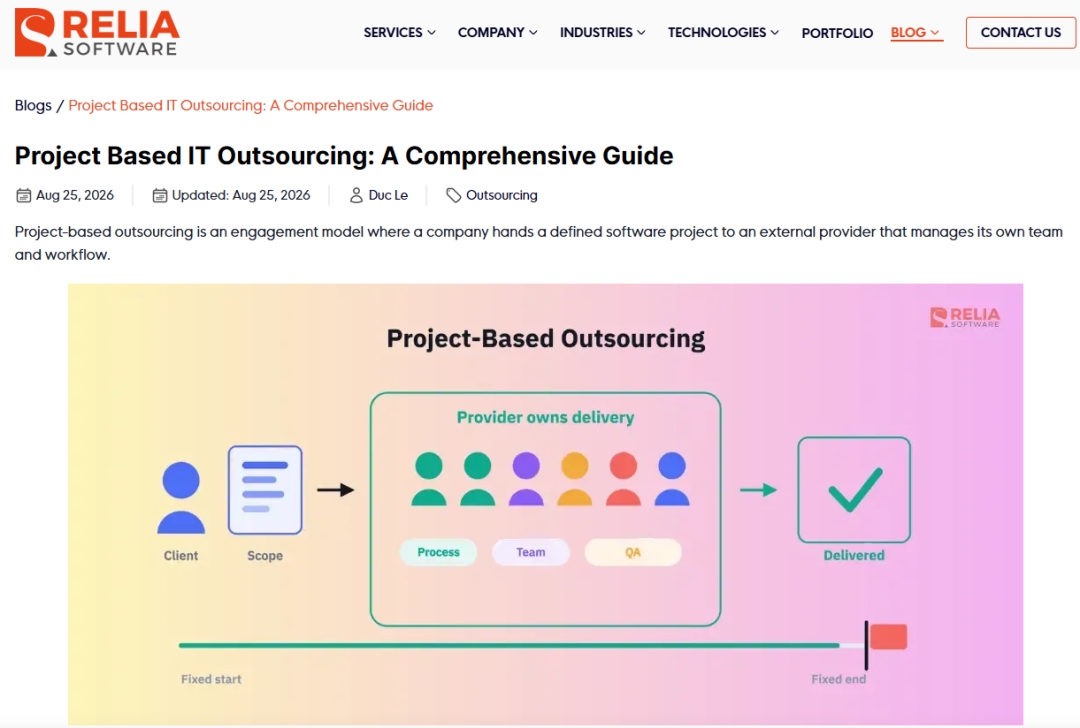
Project-based outsourcing can suit businesses with a clearly defined product scope, timeline, and set of deliverables, particularly when they want the development partner to take greater responsibility for managing the delivery process. Companies planning a larger and longer-term offshore operation may instead consider an offshore development center.
The appropriate structure depends on factors such as project scope, internal management capacity, required technical skills, expected duration, and the amount of flexibility needed during development.
Evaluating the People Behind the Project
Relia Software also encourages businesses to evaluate the actual engineers and project professionals who may work on their products rather than assessing an outsourcing company only at the corporate level.
Technical discussions can include developers, project managers, quality assurance engineers, technical leads, and solution architects where appropriate.
Using real project requirements during these discussions can help businesses understand how potential team members approach architecture, development challenges, testing, communication, and problem-solving.
Companies should also review a provider’s experience with relevant technologies and industries, development processes, security practices, communication capabilities, available team roles, and previous project experience.
Looking Beyond the Lowest Development Rate
Software development proposals can vary considerably even when vendors appear to be bidding on the same project.
A meaningful comparison should therefore consider what is included in each proposal. This can cover team composition, developer seniority, project scope, estimated timelines, quality assurance, DevOps responsibilities, project management, post-launch support, and intellectual property ownership.
A lower initial rate does not always result in a lower total project cost if additional management, redevelopment, or technical work becomes necessary later.
Defining responsibilities clearly before development begins can reduce misunderstandings as the project progresses.
Protecting Intellectual Property and Project Access
Contract terms are another important part of an offshore software development relationship.
Businesses should establish clear agreements covering intellectual property ownership, source-code ownership, confidentiality, repository access, payment terms, subcontractor involvement, change requests, termination procedures, and knowledge transfer.
Projects involving confidential information or sensitive systems may require additional controls around access to production environments, infrastructure, cloud services, credentials, and business data.
Starting Small Before Scaling
For larger or long-term engagements, Relia Software recommends establishing working processes before rapidly expanding a development team.
An initial development phase or smaller team can give both parties an opportunity to evaluate code quality, delivery consistency, documentation, communication, responsiveness, and understanding of product requirements.
Once a working relationship and development process have been established, engineering capacity can be adjusted according to the project’s requirements.
Building Communication Into the Delivery Process
International software development also requires a clear communication structure.
Companies working with teams in Vietnam can establish agreed working-hour overlap, meeting schedules, sprint lengths, documentation standards, project management tools, reporting frequency, and escalation procedures.
Clear asynchronous documentation can be especially important when teams operate across different time zones.
Rather than focusing only on hours worked, organizations can evaluate outsourcing performance through delivery outcomes such as milestone predictability, development cycle time, software quality, production issues, release frequency, budget performance, and team stability.
About Relia Software
Relia Software is a Vietnam-based custom software development company providing software development outsourcing, dedicated development teams, IT staff augmentation, project-based development, and offshore development center services. The company works with businesses on web, mobile, custom software, cloud, quality assurance, DevOps, and other software engineering requirements.
For more information, visit https://reliasoftware.com/.
Media Contact
Company Name: Relia Software
Contact Person: Duc Le
Email: Send Email
Country: Vietnam
Website: https://reliasoftware.com/


